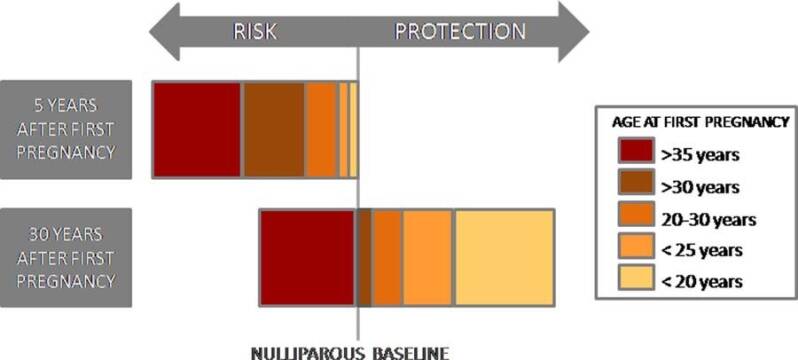
Age at first pregnancy and breast cancer risk/protection. Transient and age-independent increase of breast cancer risk during the first 5 years following parturition, A long-term protection is seen in early-pregnancy women. Women older than 35 at first full-term pregnancy result in a higher breast cancer risk compared with early-pregnancy women. The overall protective effect of parity disappears in late-pregnancy women, who at long term show higher breast cancer risk than nulliparous women Zaragoza et al IUBMB LIFE 2015
Scientific-technical, social and / or economic impact.
In Spain, breast cancer has an incidence of 66.8 per 100,000 women/year, a figure that increases at a rate of 2.5% per year. It represents 16.7% of deaths from malignant tumors, so that, despite new preventive, surgical and therapeutic advances, breast cancer continues to be the leading cause of female cancer mortality worldwide. It is currently the fourth cause of death and the first cause of potential years of life lost. As previously proven, pregnancy is associated with a reduced breast cancer risk throughout life. However, in the first five years after pregnancy, the risk of developing breast cancer increases and is even higher in women whose first pregnancy occurs an age older than 35. In this context, we are facing a scientific paradox: pregnancy can increase and decrease the risk of breast cancer depending on the period of time analyzed (while the initial effect is a short-time increase in risk, the overall effect is protective). Among the hypotheses to explain the increased risk of breast cancer associated with pregnancy and in line with our results, it is postulated that the involution of the mammary gland that occurs at the end of the pregnancy/ lactation cycle involves the activation of certain mechanisms favoring the generation of a pro-inflammatory microenvironment. This would explain why patients who are diagnosed with breast cancer after delivery have a worse prognosis than those who are diagnosed with the disease during pregnancy (McDaniel, Am J Pathol 2006; Lyons, Nat Med 2011; Obr & Edwards, Mol Cell Endocrinol 2012).
In this context, understanding the molecular mechanisms underlying the complex network of involution will contribute to establish the molecular basis for the breast cancer risk associated to pregnancy and lactation. In addition, the role of CAPN2, a pleiotropic protein highly dependent on the tissue microenvironment will be studied in the pro-inflammatory context of mammary gland involution. And it is precisely in that context where dysregulation of CAPN2 might have an impact on breast cancer risk.